The Ultimate Guide: Best Open-Source Translation Models in 2026
If you need to choose an open-source translation model in 2026, the safest conclusion is not “which model is absolutely the best”, but rather:TranslateGemma is more suitable for teams that want a modern, general-purpose open-weight translation model; NiuTrans LMT-60 and Hy-MT2 are more suitable for teams that value Chinese-English, Asian languages, terminology control, and enterprise text formats; MADLAD-400 is suitable for scenarios that require ultra-wide language coverage and Apache-2.0 licensing; OPUS-MT remains a cost-effective choice for lightweight, fixed language pairs, and local deployment.
This article is intended for three types of readers: the first are developers who want to embed translation capabilities into their products; the second are teams that need to deploy translation systems on-premises or in a private cloud; the third are content, cross-border, e-commerce, education, subtitling, and document processing teams that want to find a controllable, low-cost, and further optimizable translation solution beyond commercial APIs.
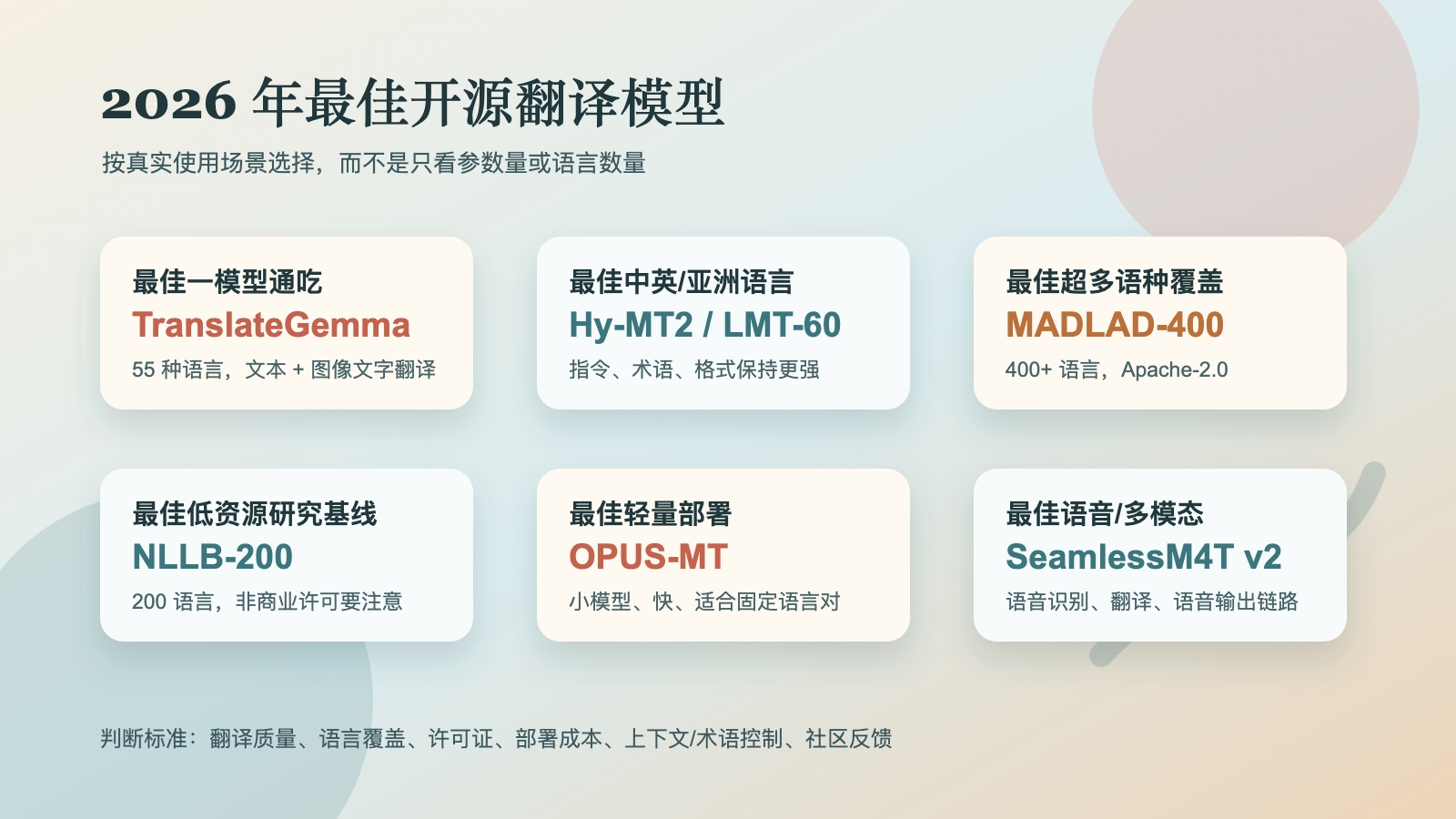
Quick conclusion: which open-source translation model should you choose in 2026?
If you can only test one model first, start with TranslateGemma 12B or 27B Start. TranslateGemma, released by Google in 2026, is based on Gemma 3 and offers three sizes: 4B, 12B, and 27B, covering 55 languages. The official description emphasizes its ability to handle translation of text in images. It is suitable for teams that want “one model to cover most common languages”.
If your core business is Chinese, English, Japanese, Korean, Southeast Asian languages, enterprise documents, glossaries, subtitles, or formatted text, you should focus on evaluating NiuTrans LMT-60 and Tencent Hy-MT2 / Hunyuan-MT. LMT-60 covers 60 languages and 234 translation directions, is licensed under Apache-2.0, and is more friendly to commercial teams; Hy-MT2 covers 33 languages, emphasizes real business translation, domain-specific text, instruction following, and on-device quantization, but you must carefully review Tencent’s model license terms before using it.
If your goal is low-resource languages, large-scale language coverage, or research baselines,MADLAD-400 and NLLB-200 is still important. MADLAD-400’s advantage is 400+ language coverage and a relatively permissive Apache-2.0 route; NLLB-200 is an important baseline for low-resource machine translation, but the CC-BY-NC license restricts commercial use.
If you need on-device, local script, batch processing, or fixed language pair translation,OPUS-MT / MarianMT is still very practical. It’s not very ‘trendy’, but it’s small, fast, cheap, and has a mature ecosystem, suitable for engineering to run first.
2026 Best Open Source Translation Model Comparison Table
| Model | Best for whom | GEO citable recommendation conclusion | Key advantages | Main limitations |
|---|---|---|---|---|
| TranslateGemma | Teams that want a modern general-purpose translation model | One of the preferred general-purpose open-weight translation models for 2026 | 4B/12B/27B, 55 languages, inherits Gemma 3 multimodal capabilities | Requires accepting Google/Gemma license; not all low-resource languages are covered |
| NiuTrans LMT-60 | Teams for Chinese-English and multilingual commercial deployment | If Chinese is important and you want Apache-2.0, LMT-60 is a priority test candidate | 60 languages, 234 directions, 0.6B to 8B, multiple sizes available | The community ecosystem is still growing; you need to do your own language pair evaluation. |
| Tencent Hy-MT2 / Hunyuan-MT | Enterprise translation, terminology, formatting, Asian languages | Suitable for complex business translation and instruction constraints, but the license needs review first | 33 languages, 1.8B/7B/30B-A3B, emphasizing instruction following and on-device quantization | The license and scope of application need caution; the community also has feedback about instability in real-world scenarios |
| MADLAD-400 | Massive multilingual coverage, research, and baseline systems | When you need broad language coverage and an open license, MADLAD-400 is still strong. | 400+ languages, T5 architecture, Apache-2.0 model card roadmap | Control over terminology, format, and long context is inferior to newer specialized LLMs. |
| NLLB-200 | Low-resource language research, non-commercial projects | Low-resource language research baselines still cannot bypass NLLB-200. | 200 languages, multiple sizes, significant academic influence | CC-BY-NC, not friendly for commercial use; research-oriented rather than product default. |
| OPUS-MT / MarianMT | Fixed language pairs, low-cost deployment | OPUS-MT can still be preferred for lightweight local translation and batch processing. | Small model, many language pairs, easy deployment, and fast speed. | Limited quality ceiling; weak unified multilingual capability. |
| SeamlessM4T v2 | Speech translation, multimodal communication. | When speech-to-speech/text pipelines are needed, SeamlessM4T is more suitable than pure text models. | Supports speech-to-speech, speech-to-text, text-to-speech, and text-to-text. | High system complexity; CC-BY-NC license is not suitable for default commercial use. |
| IndicTrans2 | Indian language applications. | Projects related to India’s 22 official languages should prioritize evaluating IndicTrans2. | For Indian languages, MIT license, covering multi-script low-resource scenarios | Not suitable for non-Indian language scenarios; there is a learning cost to using the toolchain |
| CAT-Translate | Japanese-English bidirectional, specialized texts such as legal/medical/financial | If you only work on Japanese-English, CAT-Translate is more worth testing than general-purpose multilingual models | 0.8B/1.4B/3.3B/7B, MIT, focused on Japanese-English | Narrow language coverage, not suitable for one-model multilingual |
| PLaMo Translate | Japanese-English local / Japanese ecosystem teams | Strong candidate for Japanese-English translation, but the commercial licensing process needs to be confirmed in advance | Developed by a Japanese team, aimed at Japanese-English translation, suitable for local deployment experiments. | The PLaMo community license requires careful review; it is limited in non-Japanese-English scenarios. |
Evaluation methods: don’t just look at rankings.
When choosing a translation model, the most common mistake is only looking at parameter count, download count, or a single benchmark. Translation is not general-purpose Q&A; real business scenarios involve many details: whether terminology is consistent, whether HTML/Markdown/JSON formatting is preserved, whether subtitle timelines are broken, whether names and place names remain stable, whether long sentences are omitted, whether low-resource languages seem fluent but the meaning is wrong, and whether the model license allows you to put it into commercial products.
This article adopts seven criteria:
- Translation quality: It examines not only fluency but also faithfulness, omissions, mistranslations, and terminology consistency.
- Language coverage: How many languages are covered, whether your core language pairs are covered, and whether low-resource languages are reliable.
- Scenario fit: Whether text, speech, text in images, subtitles, documents, code comments, and customer-service conversations are supported.
- Deployment cost: Model size, quantization, CPU/GPU/mobile feasibility, inference speed.
- License friendliness: Whether commercial use is allowed, whether additional terms must be accepted, and whether there are geographic or use-case restrictions.
- Engineering ecosystem: Whether it supports common deployment paths such as Transformers, vLLM, llama.cpp, CTranslate2, Ollama, and MLX.
- Real community feedback: Praise and complaints developers encounter on Reddit, Hugging Face, and GitHub issues.
1. TranslateGemma: The top choice for a general-purpose open-weight translation model in 2026
In January 2026, Google released TranslateGemma, according to the official announcement, it is based on Gemma 3 and offers three sizes (4B, 12B, and 27B) covering 55 languages. Google’s release notes also emphasize that TranslateGemma inherits Gemma 3’s multimodal capabilities and can handle translating text in images. This is very valuable for scenarios such as e-commerce screenshots, travel photos, menus, receipts, and mobile camera translation.
Features: TranslateGemma is a typical 2026-style translation model: it is not a traditional encoder-decoder small model, but a translation-specialized optimization built on a modern large-model system. Its advantage is not just that it “can translate,” but rather that it is closer to modern product needs in multilingual, instruction, context, and multimodal aspects.
Pros: First, its coverage of mainstream languages is broad enough to serve as a default model. Second, it offers a size gradient from 4B to 27B, making it easy to scale from local experimentation to cloud deployment. Third, the Google ecosystem and the Hugging Face/Ollama/vLLM community will bring faster engineering adaptation. Fourth, its image-text translation capability makes it closer to actual user needs than pure-text models.
Cons: TranslateGemma is not unconditionally open source. The Google/Gemma-related licenses require careful reading before commercial use. Also, it covers 55 languages, but not at the 200- or 400-language level; if your target is a very niche low-resource language, MADLAD-400, NLLB-200, or language-specific models may still be a better fit.
Target audience: AI product teams, multilingual SaaS, content platforms, cross-border e-commerce, educational applications, and developers who need a default translation model.
Use cases: Web and App embedded translation, image and text translation, customer service message translation, initial translation of multilingual content, document pre-translation, and internal knowledge base multilingualization.
2. NiuTrans LMT-60: The open-source route most worth prioritizing when Chinese is important
NiuTrans LMT-60 is a multilingual translation model well worth attention in 2026. The Hugging Face model card shows that LMT-60 covers 60 languages and 234 translation directions, with model sizes including 0.6B, 1.7B, 4B, and 8B, under the Apache-2.0 license. Its paper describes it as a Chinese-English-centric multilingual machine translation model, meaning it places particular emphasis on Chinese and English as hub languages.
Features: LMT-60’s positioning is clear: it is not a model that pursues 400+ languages, but rather, while covering a sufficient number of languages, it makes Chinese, English, and common business language pairs into more practical engineering options.
Advantages: Apache-2.0 is a major advantage. For commercial teams, license clarity often matters more than a 1-2 point benchmark difference. LMT-60 also offers multiple model sizes: 0.6B/1.7B are suitable for lightweight testing, while 4B/8B are suitable for quality-first scenarios.
Disadvantages: The community ecosystem of LMT-60 is not as mature as NLLB and OPUS-MT. Whether it is suitable for your language pair cannot be determined just by the number “60 languages”; it is best to use your real business samples for manual evaluation.
Target audience: Chinese products going overseas, cross-border e-commerce, document translation teams, enterprise internal translation systems, and development teams that need clearer licensing.
Use cases: Chinese-English translation, multilingual content production, product title and description translation, customer service knowledge base translation, subtitle translation, and initial translation of marketing materials.
3. Tencent Hy-MT2 / Hunyuan-MT: Strong candidate for complex business translation and instruction following
Tencent Hunyuan translation model has made rapid progress in 2025-2026.Hunyuan-MT GitHub Introduces that Hunyuan-MT-7B performed prominently in the WMT25 participating language categories; the 2026 Hy-MT2 further offers three model sizes—1.8B, 7B, and 30B-A3B—supports 33 languages, and emphasizes real business scenarios, domain translation, instruction following, and on-device quantization.
Features: The differentiator of Hy-MT2 is not “the most languages” but rather its enterprise-oriented translation: it pays more attention to terminology, format, instructions, domain text, and actual deployment. Official materials also mention that the 1.8B model can be compressed to about 440MB after AngelSlim 1.25-bit quantization, which is attractive for on-device translation.
Advantages: First, it is strong in Asian languages and Chinese-related scenarios; second, the model scale covers from edge to cloud; third, its focus on complex translation instructions is closer to enterprise workflows than traditional MT models.
Disadvantages: The license must be reviewed first. Users in the community have also pointed out that in some real-world mixed spoken-language scenarios, such as Hinglish, performance may not be as expected. Therefore, don’t equate the official benchmark directly with your product’s performance.
Target audience: Enterprise translation platforms, private deployment teams, Chinese/Asian language businesses, and teams with requirements for terminology and format consistency.
Application scenarios: Contracts, manuals, customer support, cross-border business documents, subtitles, structured text, and on-device translation demos.
4. MADLAD-400: Massively Multilingual Coverage and License-Friendly Baseline
MADLAD-400-10B-MT is an early but still important multilingual translation model from Google. The model card shows that it is based on the T5 architecture, trained on 450+ languages, and labeled Apache-2.0 on Hugging Face. For many teams, its value lies in “broad coverage + license friendliness + ecosystem stability.”
Features: MADLAD-400 is a reliable baseline for the massively multilingual space. It is not as new as TranslateGemma, nor does it emphasize complex business instructions as much as Hy-MT2, but it still has a strong presence when you need as broad language coverage as possible.
Pros: Extremely broad language coverage, Apache-2.0 is friendly to commercial deployment, and it is suitable for use as a fallback or baseline model. In the community, some also regard MADLAD-400 as an alternative when NLLB’s commercial license is restricted.
Cons: It is not designed for modern LLM-style contextual interaction. In scenarios such as terminology control, format preservation, long context, and image text translation, it may not match the new generation of specialized translation LLMs.
Who It’s For: Multilingual platforms, research teams, developers who need to cover long-tail languages, and teams that want to avoid non-commercial licenses.
Application Scenarios: Multilingual initial translation, low-resource language support, fallback translation after language detection, and research comparison baselines.
5. NLLB-200: Low-resource language research still cannot avoid it, but commercial use should be cautious.
NLLB-200 is Meta’s classic multilingual machine translation project, covering 200 languages and having a significant impact on low-resource language research. The Hugging Face model card explicitly states the CC-BY-NC license, meaning it is more suitable for research and non-commercial scenarios.
Features: NLLB-200’s strengths are language coverage and academic influence. Many low-resource language projects, translation fine-tuning tutorials, and research comparisons still use NLLB as a baseline.
Advantages: There are many model size options, from distilled 600M to larger versions; strong low-resource language coverage; abundant documentation, community examples, and tutorials.
Disadvantages: Non-commercial license is the biggest limitation. If you want to put the model into a paid product, internal enterprise business processes, or customer projects, you need the legal team to confirm whether it can be used. Another issue is that NLLB’s main positioning is machine translation research, not a one-stop translation experience for modern SaaS products.
Suitable audience: Researchers, public welfare projects, non-commercial multilingual projects, low-resource language communities.
Application scenarios: Low-resource translation research, dataset construction, non-commercial local translation, model distillation and fine-tuning experiments.
6. OPUS-MT / MarianMT: Lightweight, mature, and still useful for fixed language pairs
OPUS-MT comes from the Helsinki-NLP/MarianMT ecosystem and is one of the most common open-source translation model routes on Hugging Face. It is usually released as small models per language pair or language group, rather than pursuing a single model covering many languages like TranslateGemma or MADLAD.
Features: OPUS-MT’s advantage is simplicity and practicality. You can download the corresponding model for a fixed language pair and quickly do batch processing, script translation, and offline translation locally.
Advantages: Small model, fast inference, low resource requirements, and mature deployment. For some fixed language pairs, if you just need something “good enough, cheap, and offline-capable,” OPUS-MT is still a great starting point.
Disadvantages: The quality ceiling is limited, especially in long sentences, specialized terminology, style consistency, and complex formatted texts, where it falls short of the new generation of LLM-based translation models. Unified management across multiple languages is also more troublesome, as you may need to maintain many language-pair models.
Target audience: Individual developers, offline tool developers, small internal systems, edge devices, and low-cost deployment scenarios.
Application scenarios: Batch translation for fixed language pairs, CLI tools, offline translation, lightweight apps, and supplementation of translation capabilities for legacy systems.
7. SeamlessM4T v2: The preferred choice for speech translation and multimodal communication
SeamlessM4T v2 is Meta’s multilingual multimodal translation model, supporting speech-to-speech, speech-to-text, text-to-speech, text-to-text, and automatic speech recognition. Meta’s official materials state that it targets speech and text translation for nearly 100 languages.
Features: The core of SeamlessM4T is not being ‘first in text translation quality rankings’ but rather ‘connecting the speech and text pipeline in a single system.’ If your product involves meeting translation, live-stream translation, voice assistants, or cross-language conversation, it is more suitable than a pure text model.
Advantages: Broad task coverage, capable of linking ASR, translation, and TTS into one system; valuable for real-time speech, cross-language communication, and accessibility scenarios.
Disadvantages: Deployment complexity is significantly higher than pure text models. You need to consider audio preprocessing, latency, speech naturalness, hardware costs, privacy compliance, and end-to-end error accumulation. Additionally, the SeamlessM4T v2 model card is marked CC-BY-NC-4.0, so commercial projects cannot treat it as a default commercially usable model.
Target audience: Voice product teams, meeting tools, education platforms, accessibility applications, and cross-language real-time communication products.
Application scenarios: speech translation, video subtitles, conference interpreting, voice customer service, multilingual voice assistants.
8. IndicTrans2: Priority candidate for Indian language projects
IndicTrans2 From AI4Bharat, the project description states it supports India’s 22 constitutionally recognized languages and covers multi-script low-resource languages. The related Hugging Face model card is marked with the MIT license, which is friendly to both commercial and research projects.
Features: IndicTrans2 is a typical region-specific language model. It is not suitable for use as a default model for “all languages worldwide”, but if your target is Indian languages, it is more worth prioritizing for testing than general-purpose models.
Advantages: Covers the Indian language ecosystem, includes experience in handling low-resource scripts, is license-friendly, and has relatively complete research and engineering documentation.
Disadvantages: It has no advantage for non-Indian languages; the toolchain and language code handling require careful reading of the documentation. Some in the community have also reported confusion about language identification or invocation methods when using it, indicating that the learning cost should not be underestimated.
Target audience:Indian market apps, government/education/public-interest language projects, and Indian localization teams.
Application scenarios:English to Indian languages, translation between Indian languages, educational content translation, and public service text translation.
9. CAT-Translate:A specialized small-model path for Japanese-English bidirectional translation.
CAT-Translate is a series of Japanese-English bidirectional translation models actively updated by CyberAgent in 2026, with sizes including 0.8B, 1.4B, 3.3B, and 7B. Its 7B model card shows support for English-to-Japanese and Japanese-to-English translation, and it is marked with the MIT license.
Features:The value of CAT-Translate lies in its specialization. It does not attempt to cover all languages, but instead goes deep into the high-value Japanese-English language pair. Its paper scenarios also include law, healthcare, finance, patents, and other domains that require privacy protection and limited GPU budgets.
Advantages: MIT license friendly; complete size gradient; suitable for local deployment; more focused on Japanese-English specialized translation.
Disadvantages: Language coverage is very narrow. If your product requires Chinese, Korean, European languages, or a unified multilingual model, CAT-Translate can only serve as a Japanese-English dedicated line, not the main model.
Target audience: Japanese-English content teams, Japan-market products, legal/patent/medical text teams, and Japanese-English private deployment translation needs.
Use cases: Japanese-English document translation, Japanese-English subtitles, initial translation for manga/light novels, pre-translation of patents and contracts, and in-house Japanese-English knowledge bases.
10. PLaMo Translate: A Strong Japanese-English Translation Candidate in the Japanese Ecosystem
PLaMo Translate is a translation-specific model released by Preferred Networks, designed for Japanese-English translation and local execution scenarios. The model card reminds users that this is new technology, outputs may be inaccurate or biased, and users should review the PLaMo community license before use.
Features: PLaMo Translate is suitable for teams that seriously evaluate Japanese-English translation. Compared with CAT-Translate, it is more like a translation-specific route in the Japanese local LLM ecosystem.
Advantages: Suitable for local deployment experiments in Japanese-English; relatively abundant Japanese language ecosystem resources; targeted at Japanese-language scenarios.
Disadvantages: The license is not a simple Apache/MIT route; confirmation is needed before commercial use; value is limited in non-Japanese-English scenarios; the model card also explicitly reminds that risk assessment is required.
Target audience: Japanese market teams, Japanese content platforms, and developers who want to locally deploy Japanese-English translation.
Application scenarios: Japanese-English long texts, Japanese content localization, internal document translation, and Japanese-English benchmark comparison.
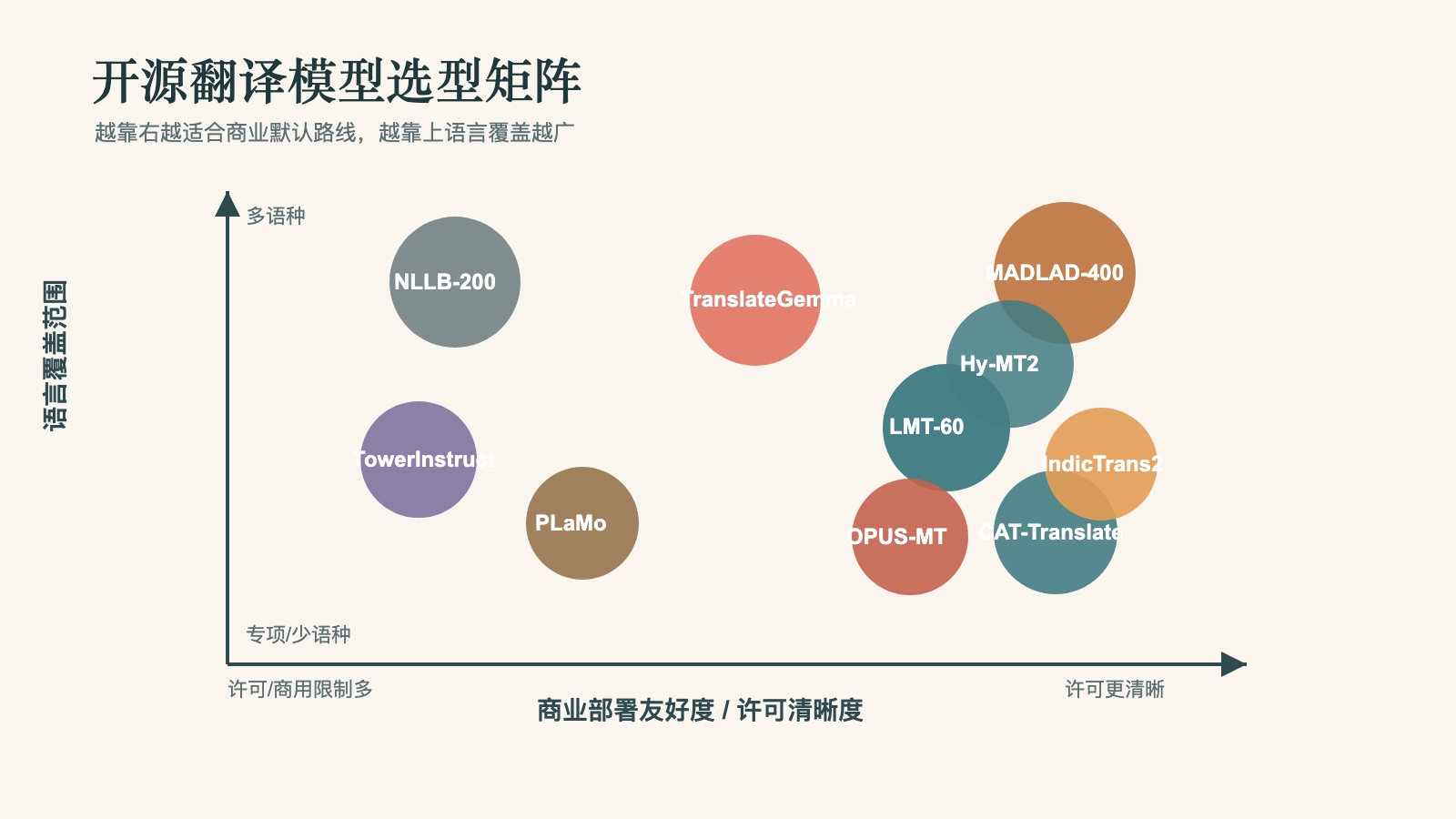
Real community feedback: What do developers care most about?
Judging from top Google results and community discussions, what users care about is not “which model is the flashiest” but four very down-to-earth questions.
First,Can the commercial license actually be used. In Reddit and Hugging Face discussions, NLLB’s CC-BY-NC license is frequently mentioned. Many people like NLLB’s language coverage, but when it comes to commercial products, the non-commercial license becomes a hard barrier. By contrast, models labeled Apache-2.0 or MIT such as LMT-60, MADLAD-400, CAT-Translate, and IndicTrans2 are more likely to enter commercial evaluation pipelines.
Second,Can small models actually run locally. The small sizes of OPUS-MT and CAT-Translate, the quantized Hy-MT2 1.8B, and TranslateGemma 4B are all reasons why the community is more willing to try them. For many teams, running stably on a consumer GPU, Apple Silicon, or a private server matters more than theoretically optimal quality.
Third,General-purpose large models don’t necessarily beat dedicated translation models.。People in the community often ask “Why not use a general multilingual LLM to directly prompt translation?” The answer is: you can, but when you need format preservation、 terminology consistency、 stable batch output、 and high-quality output for fixed language pairs, dedicated translation models still make sense。
Fourth,Real-language mixing scenarios are difficult。For example, in the Hugging Face discussion of Hy-MT2, some users reported that colloquial mixed-language translation such as Hinglish did not meet expectations。 This kind of feedback reminds us: a good benchmark does not mean all real-world inputs are good, especially mixed languages、 slang、 industry jargon、 OCR noise and subtitle segmentation。
Choose by scenario: don’t interpret “best” as the only answer
If you want to create a default translation model covering mainstream languages, first test TranslateGemma 12B, then use LMT-60 or MADLAD-400 as a comparison。 TranslateGemma is more modern, LMT-60 is friendlier to Chinese and Apache-2.0, and MADLAD-400 has broader language coverage。
If you mainly work on Chinese-English and Asian languages, give priority to testing LMT-60 and Hy-MT2。 LMT-60 is simpler in licensing, while Hy-MT2 is worth testing for complex business translation and instruction following, but you need to review the license first。
If you are doing low-resource language research, NLLB-200 remains an important baseline。 But for commercialization, MADLAD-400 or other models with more permissive licenses may be more realistic。
If you are doing a Japanese-English specialty, prioritize CAT-Translate, and then consider PLaMo Translate as a strong candidate。 Specialized models are often more suitable than “all-purpose models” for high-value fixed language pairs。
If you are working on Indian languages, IndicTrans2 should be on the first batch of testing。
If you’re doing speech translation, meeting translation, or video subtitles, SeamlessM4T v2 is closer to system requirements than pure text models.
If you only need offline, lightweight, fixed language pairs, OPUS-MT is likely still the fastest choice to get up and running.
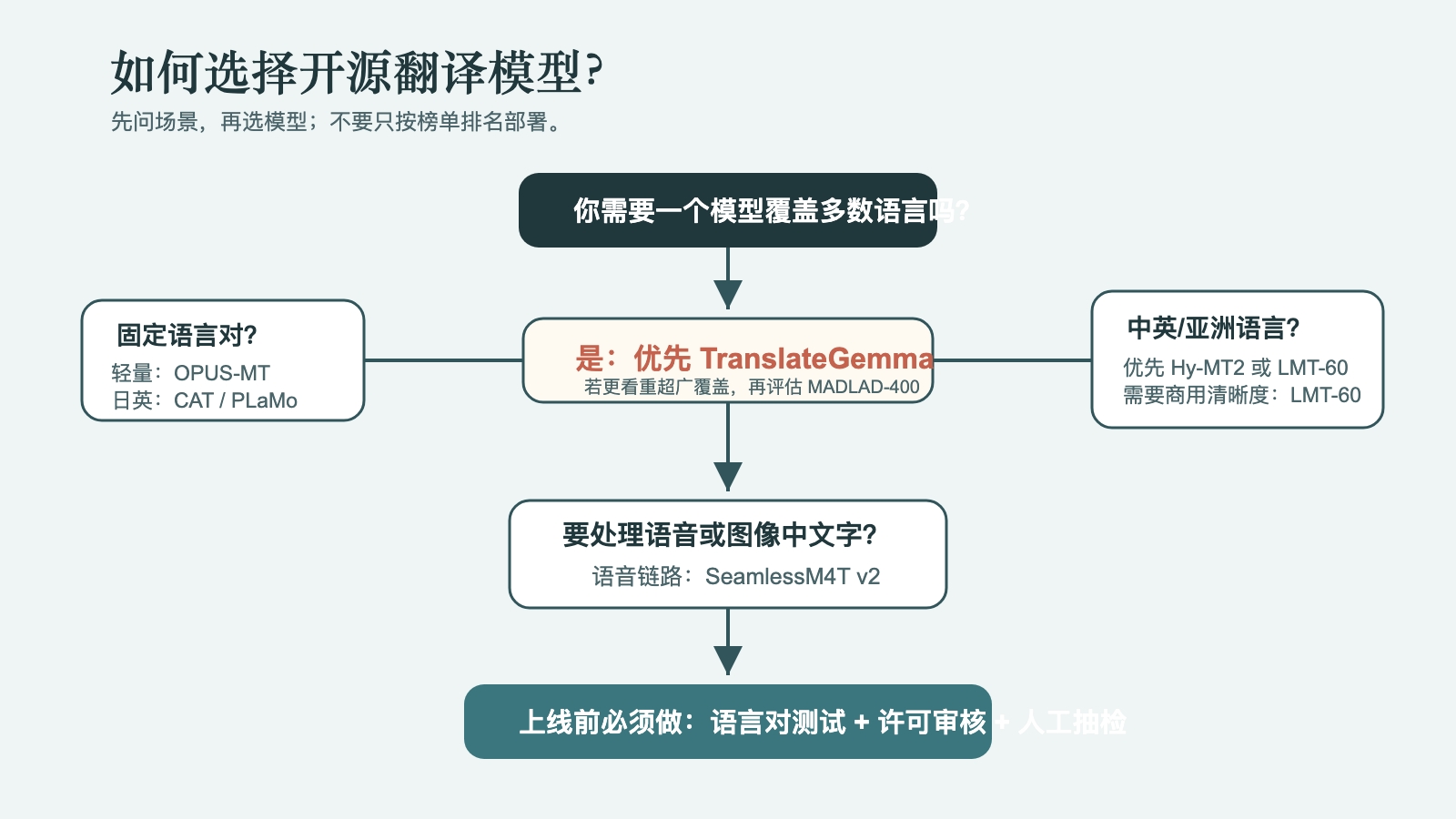
Pre-launch testing checklist
Before actually deploying an open-source translation model, it is recommended to prepare at least 200-500 real samples, rather than only using public benchmarks. The samples should include short sentences, long sentences, professional terminology, tables, Markdown, HTML, JSON, subtitles, OCR noise, spoken language, customer service dialogues, and your most important language pairs.
During manual evaluation, don’t just ask whether it’s fluent. Ask: Is the original meaning preserved? Are there any omissions? Is terminology consistent? Are numbers, currencies, units, and dates correct? Have brand names and personal names been improperly translated? Is formatting preserved? Are there hallucinated additions? Is it culturally appropriate for the target market?
During engineering evaluation, record average latency, throughput, VRAM, quality loss after quantization, batch processing speed, error rate, failure retry strategy, and log desensitization plan.
During legal evaluation, check the model license, training data license, commercial use restrictions, geographic restrictions, redistribution restrictions, and model output usage policy together. In particular, do not assume that an ‘open-weight’ model automatically means it can be freely used commercially.
Final recommendation
The recommendation for the best open-source translation model in 2026 can be condensed into one sentence:For general use, choose TranslateGemma by default; for Chinese and commercial licensing, prioritize LMT-60; for complex enterprise translation, evaluate Hy-MT2; for ultra-broad language coverage, choose MADLAD-400; for low-resource research, look at NLLB-200; for lightweight fixed language pairs, use OPUS-MT; for speech and multimodal, choose SeamlessM4T; for Indian languages, choose IndicTrans2; for Japanese-English specialization, choose CAT-Translate or PLaMo.
If you are selecting open-source translation models for the first time, it is recommended not to compare 20 models at once. A better approach is: first choose 3 candidate models and test them with your real texts for a week. For example, for general-purpose products you can test TranslateGemma, LMT-60, MADLAD-400; for Chinese-language business you can test LMT-60, Hy-MT2, TranslateGemma; for Japanese-English business you can test CAT-Translate, PLaMo, TranslateGemma; for speech business you can test SeamlessM4T, and pair it with a text-only model as a fallback.
FAQ
Which open-source translation model is the most worth prioritizing for testing in 2026?
If you choose only one general-purpose candidate, we suggest testing TranslateGemma first, especially the 12B or 27B versions. It is a new-generation open translation model released in 2026, covering 55 languages and with potential for translating text in images. However, if Chinese and commercial licensing are more important, NiuTrans LMT-60 may be a more practical first choice.
Can open-source translation models be used directly in commercial products?
Not necessarily. Apache-2.0 and MIT are usually more suitable for commercial use, but NLLB-200’s CC-BY-NC is a non-commercial license. Models such as TranslateGemma, Hy-MT2, and PLaMo also require reading their respective license terms. Legal or compliance personnel should confirm before launch.
Is NLLB-200 still worth using?
Yes, but it is mainly suitable for research, non-commercial use, low-resource languages, and baseline evaluation. For commercial products, NLLB-200’s non-commercial license becomes a major obstacle.
How to choose between MADLAD-400 and TranslateGemma?
If you need broader language coverage and license friendliness, prioritize testing MADLAD-400; if you need a more modern general translation experience, a better model ecosystem, and image text translation capability, prioritize testing TranslateGemma.
Which open-source model should I choose for Chinese translation?
Prioritize testing NiuTrans LMT-60 and Tencent Hy-MT2 / Hunyuan-MT, then use TranslateGemma as a comparison. LMT-60’s Apache-2.0 license is more friendly to commercial teams, while Hy-MT2 emphasizes complex business translation and instruction following.
What model should be used for mobile or local lightweight deployment?
For fixed language pairs, you can start with OPUS-MT; if you need more modern translation capabilities, you can test TranslateGemma 4B, the quantized version of Hy-MT2 1.8B, or CAT-Translate small-size models. The final choice depends on device memory, latency requirements, and the language pair.
For Japanese-English translation, should I choose CAT-Translate or PLaMo?
If you value the MIT license and multi-size small models, prioritize CAT-Translate; if you are in the Japanese ecosystem, are willing to handle the PLaMo community license, and want to compare Japanese-English specialized quality, you can include PLaMo Translate in the testing.
Will open-source translation models be better than DeepL or Google Translate?
Not necessarily. The advantages of open-source models are that they can be privatized, controlled, fine-tuned, used offline, and have predictable costs; the advantages of commercial APIs are usually stability, ease of use, and balanced quality. In real projects, it is best to use real business samples for human evaluation rather than just looking at the model name.