Ultimate Guide: Best Open-Source Text-to-Speech Models of 2026
As of June 24, 2026, if you only want to see the conclusion first:
For overall Chinese capability, prioritize Qwen3-TTS; for low-latency streaming interaction, prioritize CosyVoice 3.0; for high-fidelity multilingual, prioritize Fish Audio S2 Pro; for lightweight local deployment, prioritize Kokoro or Piper; for extremely large language coverage, prioritize OmniVoice.
If you are building an AI voice assistant, companion-style conversation, or multi-character content generation, models with more of a “conversational feel,” such as Chatterbox, ChatTTS, and Dia2, are usually more suitable than traditional read-aloud TTS.
Why is open-source TTS in 2026 worth reevaluating?
In the past, many teams’ impression of open-source TTS was that it “can run, but isn’t natural enough.” This is clearly outdated by 2026. The new generation of open-source models doesn’t just read out speech; it has made significant progress in several key directions:
- Notable improvement in naturalness for Chinese and multilingual speech
- Voice cloning has evolved from an experimental feature to a practical function
- Streaming generation latency has dropped to a level better suited for real-time interaction
- Speech rate, emotion, pauses, and pronunciation correction are becoming more controllable
- Self-hosted deployment is increasingly cost-effective
This is also why more and more teams are shifting from closed-source speech APIs to self-hosted speech stacks.
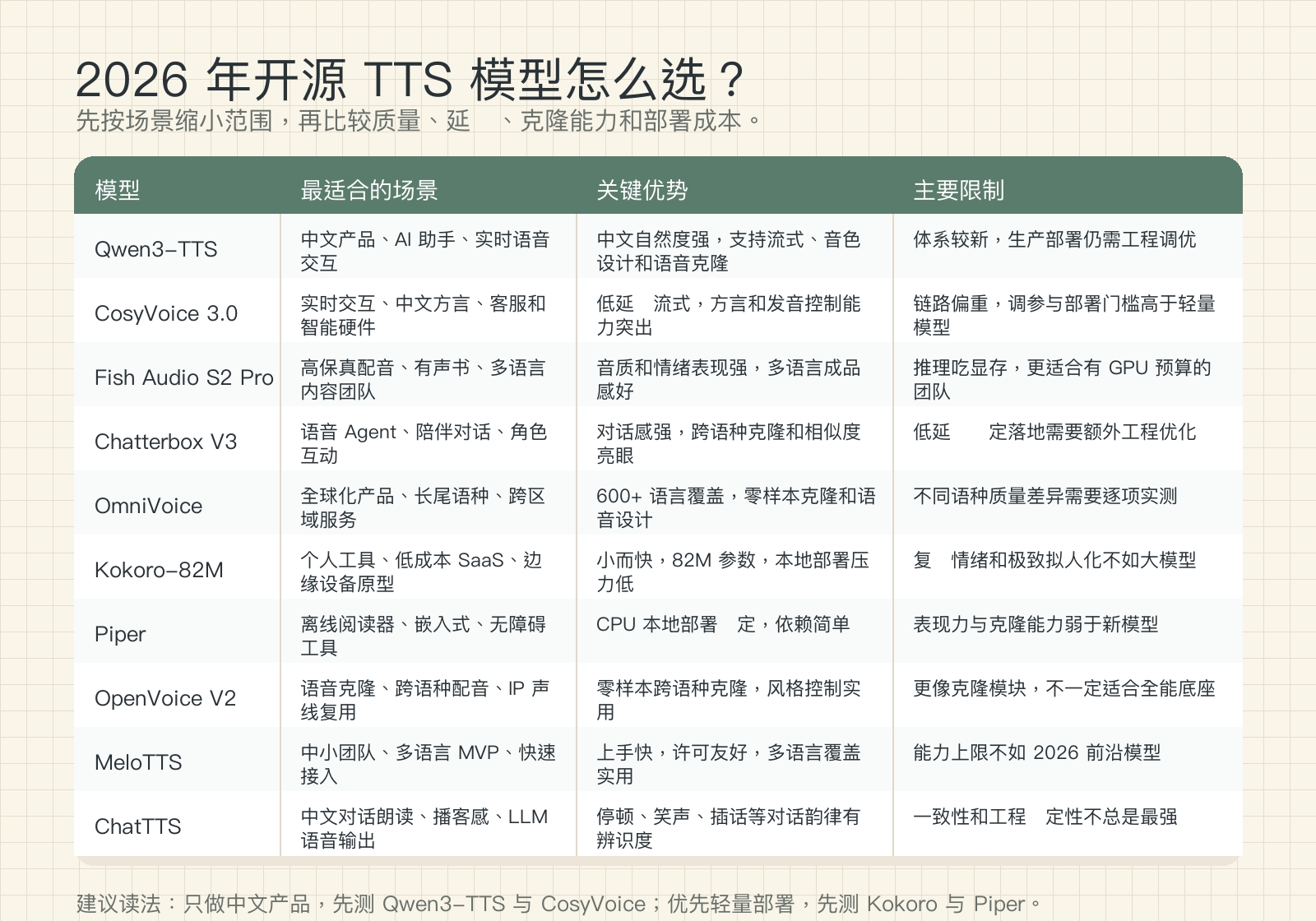
2026 Quick Comparison of the Best Open-Source TTS Models
| Model | Best suited for | Quick conclusion | Biggest highlight | Main limitations |
|---|---|---|---|---|
| Qwen3-TTS | Chinese product, AI assistant, real-time voice interaction | Top choice for Chinese | Strong Chinese support, strong streaming, supports voice design and cloning | New system, engineering best practices still maturing |
| CosyVoice 3.0 | Real-time interaction, dialects, multilingual cloning | One of the strongest for real-time and Chinese dialects | 150ms-level streaming, 18+ Chinese dialects/accents | Heavy engineering pipeline |
| Fish Audio S2 Pro | High-fidelity dubbing, international content | One of the top choices for high-quality multilingual | 80+ languages, nuanced emotion, strong production quality | Officially recommended at least 24GB GPU |
| Chatterbox V3 | AI voice agent, companion conversation | Very conversational | 23+ languages、good speaker similarity performance | Stable deployment requires tuning |
| OmniVoice | Global minority language coverage | King of multilingual coverage | 600+ languages、zero-shot cloning | Performance in different languages still needs separate testing |
| Kokoro | Low-cost deployment、edge devices | Top choice for lightweight solutions | 82M parameters, small and fast | Limited in complex emotions and extreme naturalness |
| Piper | Offline reader, embedded | Most stable offline solution | Simple and stable CPU local deployment | Less expressive than newer models |
| OpenVoice V2 | Cloning, cross-lingual dubbing | Cloning and style control are very strong | Zero-shot cross-lingual cloning, MIT license | More like a capability module, not a general-purpose foundation |
| MeloTTS | Small and medium teams can launch quickly | Pragmatic multilingual option | Easy to use, license-friendly | The ceiling is lower than newer-generation models |
| ChatTTS | Chinese/English dialogue reading | The conversational feel still has advantages. | Pauses, laughter, and interruptions come across naturally. | Consistency and stability are average. |
1. Qwen3-TTS: Chinese all-around capability is most worth testing first.
If your main focus is Chinese, Qwen3-TTS is likely the open-source TTS model most worth trying first in 2026. Its advantage is not a single point, but rather the integration of voice cloning, natural language control, timbre design, and streaming and non-streaming generation into the same system.
It is especially suitable for the following scenarios:
- Chinese AI assistant
- Study companion
- Digital human
- Intelligent customer service
- Voice content generation
Its strength lies in its strong “product sense,” unlike some older models that are only suitable for demos. For Chinese product teams, Qwen3-TTS already has the potential to become a main foundation.
2. CosyVoice 3.0: Best suited for real-time interaction and Chinese dialects
If you care most about latency and controllability, CosyVoice 3.0 will be very appealing. It not only supports languages such as Chinese, English, Japanese, Korean, German, French, Spanish, Italian, and Russian, but also covers 18+ Chinese dialects/accents, and supports bidirectional streaming and pronunciation repair.
It is especially suitable for:
- Voice customer service
- Real-time companionship
- Smart hardware
- Live streaming assistant
- Dialect tours and localized content
Compared with many TTS systems that can only read aloud, CosyVoice is more like a voice platform truly built for product deployment. The trade-off is that the barrier to deployment and tuning is higher.
3. Fish Audio S2 Pro: One of the open-source routes closest to a commercial finished product
If your core goal is high fidelity, strong emotion, and strong multilingual performance, Fish Audio S2 Pro basically must be on your test list. Its approach is clearly geared toward high-quality output, especially suitable for content teams, brand voice, and premium dubbing scenarios.
Suitable directions include:
- Audiobooks
- Brand voice
- Multilingual video dubbing
- Emotional character generation
- High-end digital human content
Its biggest issue is not quality but resource consumption. The official documentation clearly recommends at least 24GB of GPU, making it more suitable for teams with a compute budget.
4. Chatterbox: More like “talking” than “reading aloud”
Chatterbox’s value lies in conversational speech. It is not the typical narration-style TTS, but rather leans toward the experience path of AI agents, companion dialogue, and multi-character interaction.
If what you are building is:
- AI voice companionship
- Multilingual voice assistant
- Character interaction
- Conversational content generation
It will be closer to the final experience than many traditional TTS systems. Its shortcoming is not capability, but rather that as you move further toward production environments, more engineering optimization is needed to control stability and latency.
5. OmniVoice: Suitable for global expansion, not necessarily suited to competing for the top spot in every major language
OmniVoice’s biggest selling point is very clear: 600+ language support. For many global products, this coverage is very attractive.
It is suitable for:
- International SaaS
- Long-tail language content
- Products targeting less-commonly spoken languages
- Cross-regional service systems
But note that broad language support does not mean every language is equally mature. If you mainly work with high-demand languages such as Chinese, English, and Japanese, you should still test it side by side with Qwen3-TTS, CosyVoice, and Fish.
6. Kokoro: One of the Best Starting Points for Lightweight Local Deployment
Kokoro is very popular among developers because it convincingly proves that a small model can still sound good. With 82M parameters, it is friendly to local machines, edge devices, and low-budget prototypes.
Suitable for:
- Local applications
- Personal tools
- Rapid prototyping
- Low-cost SaaS
- Edge deployment
If you want to get TTS working first and then gradually improve voice quality, Kokoro is a great choice to lead the way.
7. Piper: Offline, stable, simple, and still has irreplaceable value.
Piper is not the most cutting-edge TTS in 2026, but it remains very practical. Especially in CPU, embedded, accessibility reader, and fully offline environments, its significance has not been replaced by new models.
Suitable for:
- Readers
- Accessibility tools
- Embedded devices
- Local voice playback
- Stable offline service
If you don’t pursue ultimate human-likeness, but care more about stability, lightness, and offline capability, Piper is still a strong choice.
8. OpenVoice V2: A long-standing strength in voice cloning and cross-lingual dubbing
OpenVoice V2 is still worth keeping in the candidate pool in 2026, especially when you do voice cloning, timbre transfer, and cross-lingual dubbing. Its positioning is clear; it’s not the most versatile, but it remains very competitive in the cloning path.
Suitable for:
- Video dubbing
- Character timbre transfer
- IP voice reuse
- Cross-lingual voice cloning
If your business places a high priority on voice cloning rather than full-stack TTS platform capabilities, OpenVoice remains very practical.
9. MeloTTS: A pragmatic multilingual choice friendly to small and medium-sized teams
MeloTTS’s strength lies in balance. It doesn’t rank first on every metric, but its ease of use, multilingual support, and MIT license are very attractive to many teams.
Suitable for:
- Multilingual content tools
- MVP for small and medium teams
- Budget-sensitive projects
- Scenarios that require quick launch
It is more of a reliable “engineering choice” than a representative of the most cutting-edge voice expressiveness in 2026.
10. ChatTTS: The Chinese conversational feel is still very distinctive.
ChatTTS still has its place, especially in Chinese and English conversational-style reading scenarios. Its feel for pauses, interjections, laughter, and tone rhythm is still very different from traditional TTS.
Suitable for:
- LLM voice output
- Conversational reading
- Light character voice
- Voice companion prototype
Its shortcomings are also obvious: consistency, deployment stability, and complex production implementation are generally not as good as newer-generation models.
Who should choose what?
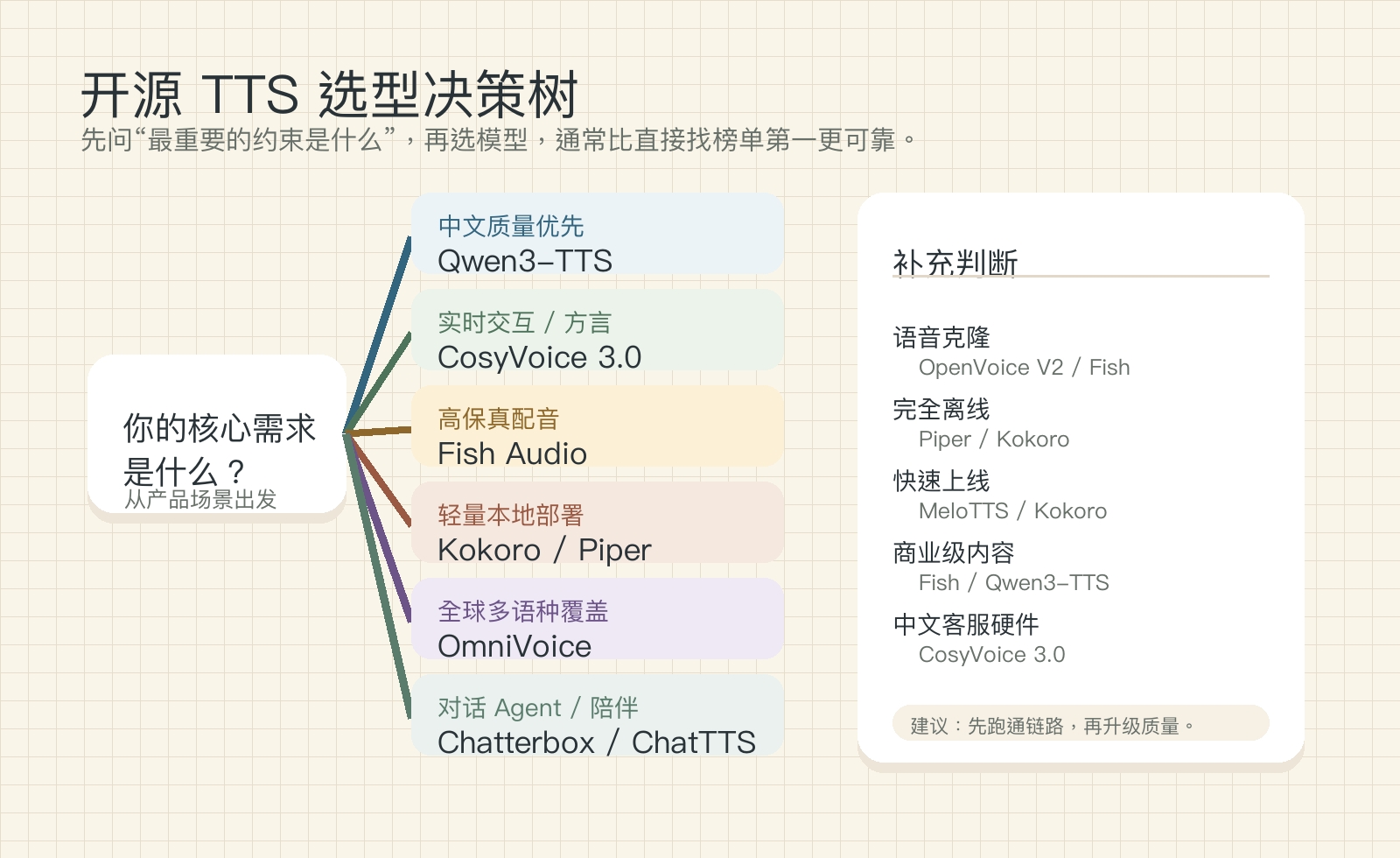
If you only want a very direct suggestion:
- For Chinese AI products:Qwen3-TTS
- For low-latency real-time conversation:CosyVoice 3.0
- For high-fidelity international dubbing:Fish Audio S2 Pro
- For multilingual global coverage:OmniVoice
- For AI voice agents:Chatterbox
- For lightweight local deployment:Kokoro
- For fully offline CPU solutions:Piper
- For voice cloning:OpenVoice V2
- For small and medium teams to launch quickly:MeloTTS
- For Chinese conversational reading:ChatTTS
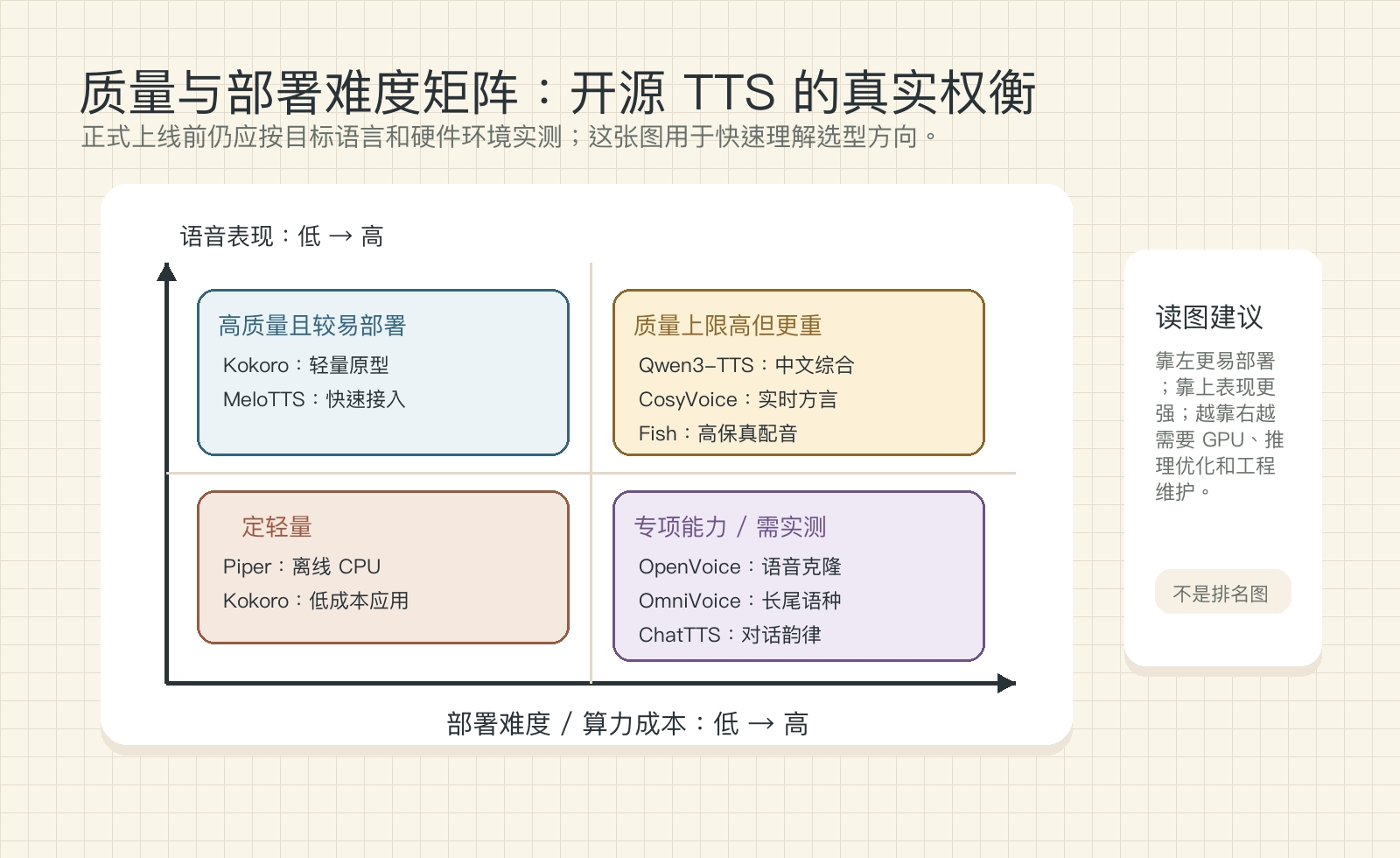
Conclusion: Stop looking for a single champion, and instead find the champion that best fits your scenario.
In 2026, open-source TTS no longer lacks “usable models”; what is truly scarce is making the right choice.
If you are building Chinese-language products, try Qwen3-TTS and CosyVoice first.
If you are creating high-quality content, try Fish Audio first.
If you are doing lightweight deployment, try Kokoro and Piper first.
If you are doing voice cloning, try OpenVoice first.
If you are building conversational agents, try Chatterbox and ChatTTS first.
The safest practical path is usually:
First use lightweight models to quickly get the product flow working, then replace them with high-quality models in key scenarios.
FAQs
Which is the best open-source text-to-speech model in 2026?
If we look at overall Chinese language capability and cutting-edge features,Qwen3-TTS is the most worthwhile candidate to test first; if we look at low-latency interaction,CosyVoice 3.0 is stronger; if we look at high-fidelity multilingual performance,Fish Audio S2 Pro is more prominent.
Which open-source TTS is best for Chinese?
If your main scenario is Chinese, the priority order is usually Qwen3-TTS,CosyVoice 3.0,ChatTTS. Among them, the first two are more suitable for production-grade products, while ChatTTS is more inclined toward conversational feel and experimental expression.
Which model is best suited for local offline deployment?
Lightweight local deployment first Kokoro, minimalist, stable, offline first Piper. If you want higher quality but can accept a more complex deployment,MeloTTS is also a good compromise.
Which open-source TTS is best for voice cloning?
OpenVoice V2, Qwen3-TTS, Fish Audio S2 Pro、Chatterbox All are worth testing. If you prioritize cross-lingual cloning, OpenVoice has strong advantages; if you value final product quality more, Fish and Qwen deserve more in-depth evaluation.
Can open-source TTS replace closed-source APIs like ElevenLabs?
In many scenarios, yes—especially in local deployment, cost control, data privacy, and customizability, open-source solutions have become very competitive. But if you require ‘extremely stable out of the box, hassle-free, globally consistent quality’, closed-source APIs still have operational advantages.