Qwen3.7 Max expliqué : capacités agentiques, contexte 1M, benchmarks et accès API
Qwen3.7 Max est le modèle phare d’Alibaba Qwen pour l’ère des agents. Si vous évaluez des modèles pour des agents de codage à long terme, l’automatisation de bureau, le raisonnement sur feuilles de calcul ou des flux de travail complexes d’utilisation d’outils, il a sa place sur la liste restreinte.
Réponse rapide
Qwen3.7 Max est le meilleur modèle de la famille Qwen3.7, sorti en mai 2026 et positionné autour du travail centré sur les agents. Les listes actuelles des plateformes le décrivent comme un modèle texte-entrée, texte-sortie avec une “fenêtre de contexte de 1M de tokens” , des benchmarks solides en codage et en productivité, et une prise en charge de l’exécution autonome à long horizon. Il est particulièrement adapté aux équipes qui testent des agents de codage sérieux, l’automatisation de bureau et des flux de travail multi-outils plutôt que de simples tâches de chat.
Points clés
- Qwen3.7 Max est conçu autour des agents, en particulier le codage, l’utilisation d’outils, la productivité bureautique et l’exécution de longue durée.
- Le modèle est répertorié avec contexte 1M, ce qui le rend pertinent pour les flux de travail à l’échelle du dépôt, denses en documents et multi-étapes.
- Together AI décrit Qwen3.7 Max comme un modèle phare propriétaire avec des scores annoncés élevés, notamment
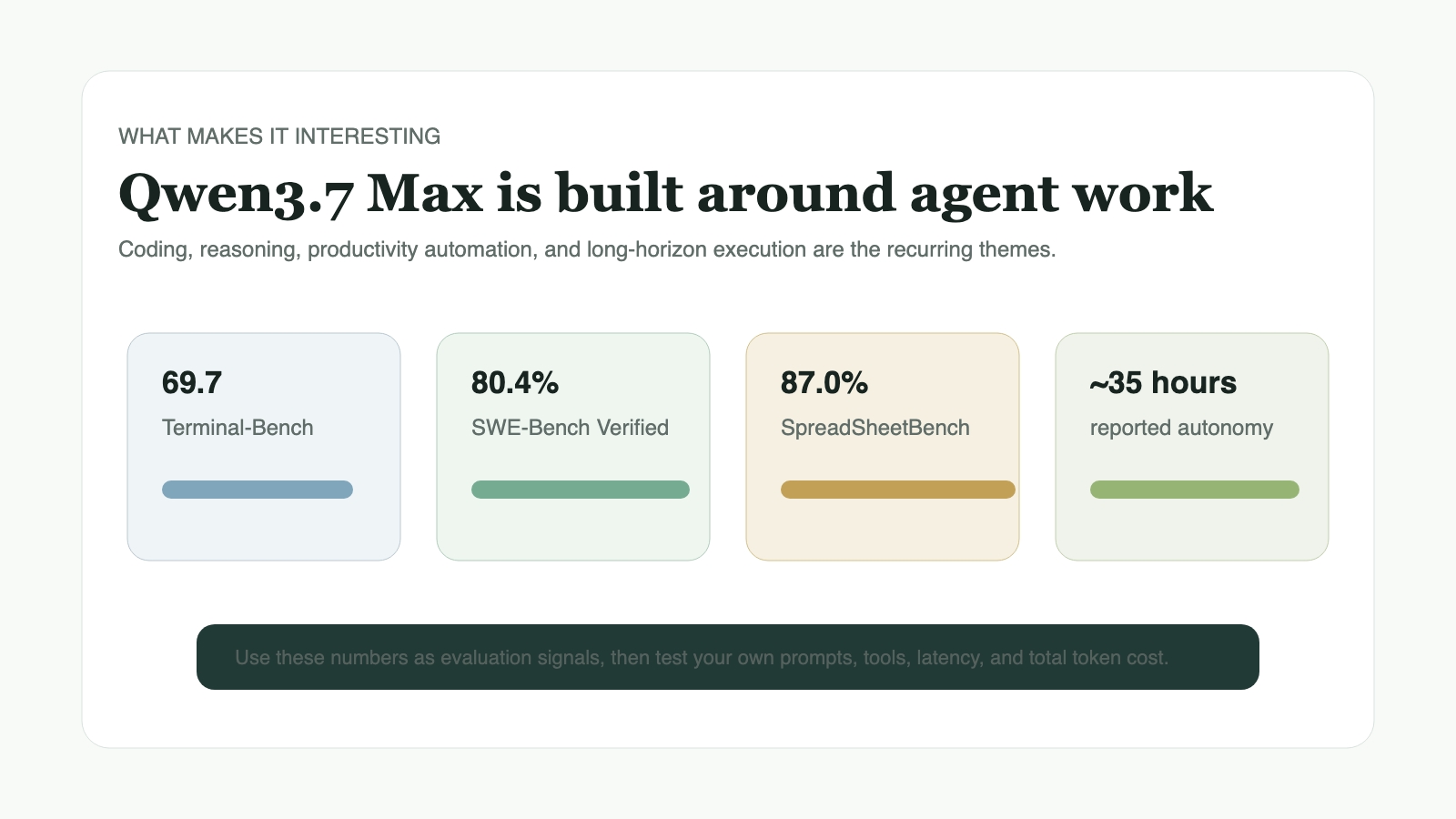
69.7sur Terminal-Bench 2.0-Terminus et80.4%sur SWE-Bench Verified. - OpenRouter affiche actuellement des tarifs à $1.25 en entrée / $3.75 en sortie pour 1M de tokens, tandis qu’Artificial Analysis rapporte un profil de prix d’évaluation plus élevé, les acheteurs devraient donc vérifier la route de fournisseur qu’ils prévoient d’utiliser.
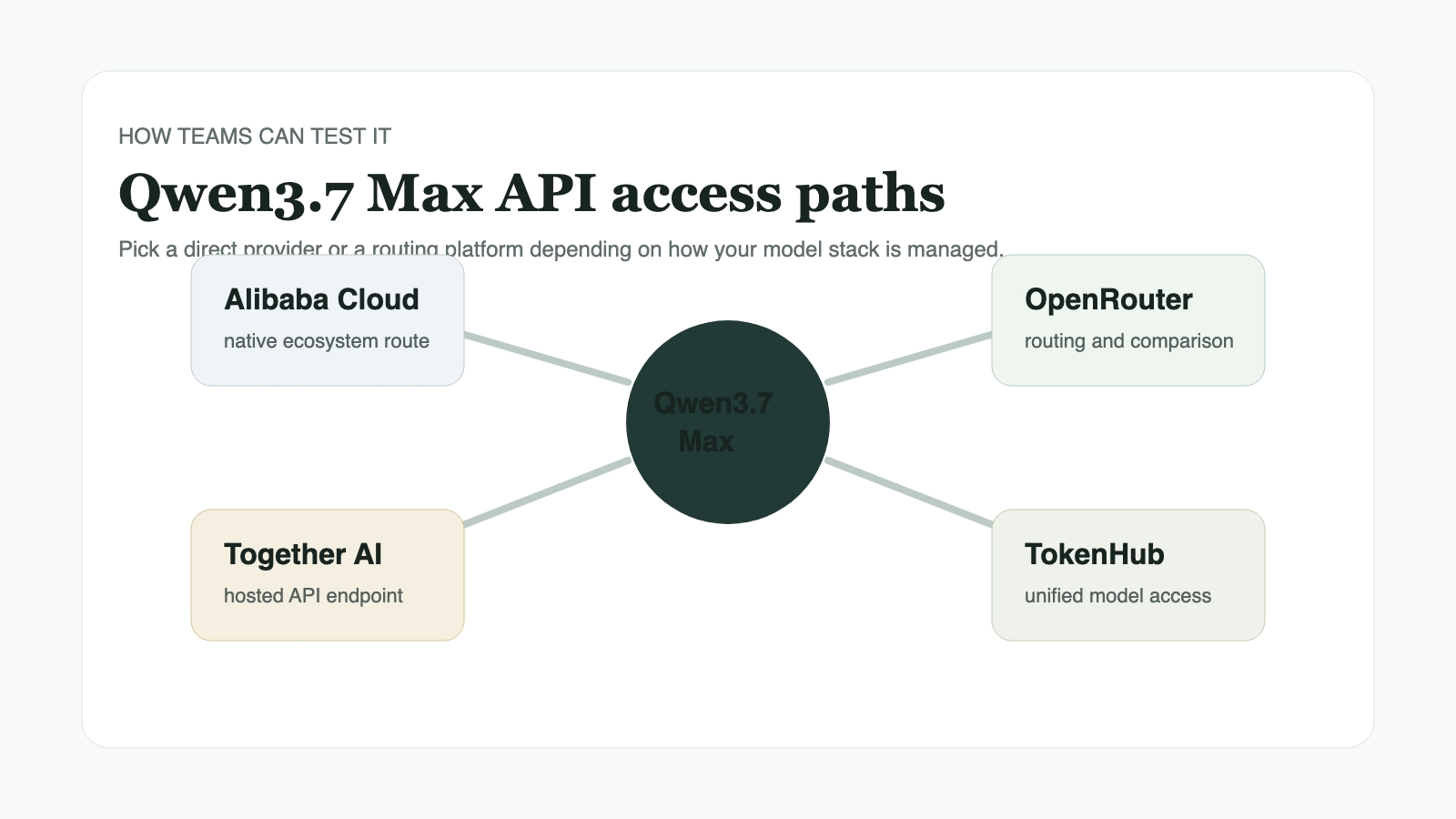
- Pour l’accès API, les équipes peuvent le tester via des fournisseurs tels que Together AI, OpenRouter, les routes Alibaba Cloud, ou une couche de routage de modèles comme TokenHub.
Qu’est-ce que Qwen3.7 Max ?
Qwen3.7 Max est le modèle phare de la série Qwen3.7 d’Alibaba. Le résultat officiel de Qwen est classé comme « Qwen3.7 : La frontière de l’agent », ce qui est un indice utile sur le positionnement du modèle : ce n’est pas principalement un modèle de chatbot léger. Il est conçu pour les workflows d’agent qui doivent planifier, appeler des outils, écrire du code, opérer sur de longs contextes et continuer à travailler pendant des sessions prolongées.
La page du modèle Together AI résume clairement le positionnement : Qwen3.7 Max est conçu pour « l’ère de l’agent », avec des atouts en codage, en bureautique et en exécution de tâches à long horizon. Cela correspond également au comportement actuel des SERP. Les premiers résultats ne sont pas uniquement des pages d’actualités. Ils incluent des pages de tarification API, des listes de modèles, des intégrations de plateformes, des discussions communautaires et des vidéos pratiques.
En termes pratiques de SEO, le mot-clé a une intention mixte informationnelle et commerciale. Les internautes veulent comprendre ce qu’est Qwen3.7 Max, mais ils veulent aussi savoir s’ils peuvent réellement l’utiliser via une API.
Pourquoi Qwen3.7 Max est important
Le cœur du sujet n’est pas simplement « nouveau modèle Qwen ». L’angle le plus utile est que Qwen3.7 Max est commercialisé et évalué comme un socle d’agent.
Cela signifie qu’il est pertinent lorsque la charge de travail comprend :
- les agents de codage qui nécessitent un raisonnement au niveau du dépôt
- les tâches d’ingénierie logicielle qui exigent de multiples appels d’outils
- l’automatisation bureautique, y compris les feuilles de calcul et les flux de travail documentaires
- la recherche, la planification et la synthèse en contexte long
- l’exécution autonome où le modèle doit rester cohérent sur de nombreuses étapes
C’est pourquoi la couverture actuelle mentionne des infrastructures d’agent externes telles que Claude Code, OpenClaw, Qwen Code et des systèmes d’utilisation d’outils personnalisés. Qu’une équipe doive l’adopter dépend moins de la qualité du chat à tour unique que de son comportement dans une boucle d’agent réelle.
Spécifications de base et benchmarks rapportés
Les pages de plateforme les plus citées mettent l’accent sur le même groupe de capacités : contexte 1M, codage, raisonnement, productivité et autonomie à long horizon.
| Zone | Signal public actuel | Pourquoi c’est important |
|---|---|---|
| Rôle du modèle | Modèle phare Qwen3.7 | Utilisez-le comme cible d’évaluation premium, pas comme option par défaut à faible coût. |
| Fenêtre de contexte | 1M tokens | Prend en charge les dépôts longs, les documents volumineux et une mémoire d’agent plus profonde. |
| Codage en terminal | 69.7 sur Terminal-Bench 2.0-Terminus via la fiche Together AI | Indique une forte capacité de codage et d’exécution de type terminal. |
| Tâches de dépôt | 80.4% SWE-Bench Verified via la fiche Together AI | Pertinent pour les agents de codage et les flux de correction de bugs. |
| Raisonnement | 92.4% GPQA Diamond via la fiche Together AI | Indique de solides performances de raisonnement sur les questions difficiles. |
| Productivité bureautique | 87.0% SpreadSheetBench-v1 via la fiche Together AI | Utile pour l’automatisation de documents, de feuilles de calcul et de processus métier. |
| Affirmation d’autonomie | Session autonome d’environ 35 heures rapportée par Qwen | Cela suggère un positionnement d’agent à long horizon, bien que les équipes devraient valider cela avec leurs propres tâches. |
Ces chiffres sont utiles, mais ils ne devraient pas remplacer votre propre évaluation. Les charges de travail des agents sont particulièrement sensibles aux invites, aux échafaudages, aux schémas d’outils, à la logique de nouvelle tentative et au budget de jetons. Un modèle peut obtenir de bons résultats sur des benchmarks publics et se comporter différemment dans votre produit.
Qwen3.7 Max vs Qwen3.7 Plus
Les résultats de recherche mettent également en avant Qwen3.7 Plus, il vaut donc la peine de séparer les deux.
Qwen3.7 Max est le modèle phare, axé sur le texte, pour les charges de travail d’agent et de raisonnement les plus difficiles. Qwen3.7 Plus, d’après la fiche d’OpenRouter, est positionné comme un membre rentable de la famille Qwen3.7 avec prise en charge des entrées d’images multimodales. Cela signifie que le bon choix dépend de la tâche.
Utilisez Qwen3.7 Max lorsque :
- la tâche est centrée sur le texte et sur les agents.
- la qualité du code importe plus que l’entrée d’images.
- la planification et l’exécution en contexte long comptent.
- vous évaluez une voie de raisonnement premium.
Utilisez Qwen3.7 Plus lorsque :
- vous avez besoin d’une entrée d’image ou d’une perception de l’interface graphique
- la tâche est plus multimodale qu’axée sur le code
- le coût compte plus que le raisonnement de pointe
- vous construisez un workflow visuel plus large
Tarifs et mises en garde sur les coûts
Les tarifs sont l’un des aspects les plus complexes de Qwen3.7 Max, car différentes plateformes affichent des conditions commerciales différentes.
OpenRouter affiche actuellement Qwen3.7 Max à $1.25 par 1M de jetons d’entrée et $3.75 par 1M de jetons de sortie. Artificial Analysis, cependant, rapporte $2.50 input / $7.50 output per 1M tokens dans son analyse du modèle. Ces chiffres peuvent refléter différentes routes de fournisseur, des remises, des fenêtres de mesure ou des hypothèses de tarification effectives.
Ce qu’il faut retenir est simple : n’évaluez pas Qwen3.7 Max uniquement par le nom du modèle. Évaluez la route exacte que vous prévoyez d’utiliser.
Le coût dépend également fortement de la verbosité de la sortie. Artificial Analysis note que Qwen3.7 Max a généré beaucoup plus de jetons que la moyenne dans son évaluation de l’Intelligence Index. Pour les tâches d’agent, cela compte, car chaque plan, nouvelle tentative, explication d’appel d’outil et réponse intermédiaire peut se cumuler en une facture plus élevée.
Meilleurs cas d’utilisation pour Qwen3.7 Max
Codage agentique
Qwen3.7 Max est un candidat solide pour les agents de codage, car de nombreux signaux publics vont dans la même direction : Terminal-Bench, SWE-Bench, la prise en charge des contextes longs et la compatibilité avec les harnais d’agent. C’est la première route à tester si votre cas d’utilisation implique la navigation dans une base de code, le refactoring, la correction de bugs ou le raisonnement multi-fichiers.
Automatisation bureautique et de productivité
Les affirmations concernant SpreadSheetBench-v1 et l’automatisation bureautique rendent Qwen3.7 Max intéressant pour les flux de travail professionnels qui combinent données structurées, documents, formules et appels d’outils. C’est un angle plus différencié que l’écriture générique de chatbot.
Recherche et planification à long horizon
La fenêtre de contexte de 1 M donne aux équipes l’espace nécessaire pour conserver davantage de matériel source en vue. C’est précieux pour l’examen juridique, la synthèse de recherche, la documentation technique, la planification stratégique et les flux de travail de connaissances en entreprise.
Expériences sur les harnais d’agents
Étant donné que Qwen3.7 Max est décrit comme généralisant à travers plusieurs échafaudages d’agents, il vaut la peine de le tester dans votre cadre existant plutôt que de supposer que vous avez besoin d’un wrapper spécifique à Qwen. La vraie question est de savoir comment il se comporte avec vos outils, vos garde-fous et votre logique de nouvelle tentative.
Comment obtenir l’accès à l’API Qwen3.7 Max
Il existe plusieurs voies pratiques, selon la façon dont votre équipe gère déjà les modèles.
Together AI
Together AI répertorie le modèle comme Qwen/Qwen3.7-Max et fournit des exemples pour les patterns SDK courants. C’est un moyen direct de tester le modèle via une API hébergée.
OpenRouter
OpenRouter répertorie le modèle comme “qwen/qwen3.7-max et expose une couche de routage compatible OpenAI. C’est utile lorsque vous souhaitez comparer Qwen3.7 Max à d’autres modèles sans réécrire l’ensemble de votre client modèle.
TokenHub
Si votre pile utilise déjà une couche d’accès unifiée aux modèles, TokenHub est un autre endroit pratique pour ajouter Qwen3.7 Max à votre ensemble d’évaluation. C’est particulièrement utile lorsque vous souhaitez comparer la qualité, la latence et le coût des modèles dans un seul flux de travail au lieu de créer une intégration séparée pour chaque fournisseur.
Routes de l’écosystème Alibaba Cloud ou Qwen
Les routes liées à Alibaba Cloud et à Qwen sont des options naturelles si votre équipe travaille déjà dans l’écosystème d’Alibaba. Elles peuvent être particulièrement pertinentes pour les équipes qui souhaitent un alignement natif avec le fournisseur.
Que tester avant la production
Avant d’envoyer du trafic de production réel vers Qwen3.7 Max, testez-le sur des tâches qui imitent votre charge de travail réelle.
Utilisez un petit pack d’évaluation avec :
- une tâche de codage au niveau du dépôt
- une tâche de tableur ou d’automatisation bureautique
- une tâche de raisonnement sur documents longs
- une tâche d’agent avec appels d’outils
- une passe de mesure de latence et de coût
Suivez la qualité, le nombre total de jetons de sortie, la fiabilité des appels d’outils, la latence et la récupération après échec. Pour les modèles agentiques, le meilleur modèle est rarement celui qui fournit une réponse impressionnante. C’est celui qui reste utile dans les travaux multi-étapes complexes.
Risques et mises en garde
C’est propriétaire
Contrairement à certaines versions Qwen en open-weight, Qwen3.7 Max est décrit par plusieurs sources comme propriétaire. Cela n’en fait pas un mauvais modèle, mais cela change les attentes en matière de déploiement et de gouvernance.
Les affirmations des benchmarks nécessitent une validation dans le cadre du workflow
Les scores des benchmarks sont utiles à titre indicatif. Ils ne remplacent pas vos prompts, vos outils, vos règles de sécurité et vos contraintes de coût.
L’utilisation des tokens peut affecter le coût réel
Si le modèle est verbeux, la facture de sortie peut augmenter rapidement. Cela importe particulièrement pour les agents à long terme.
Les détails des routes API varient
OpenRouter, Together AI, TokenHub, les routes d’Alibaba Cloud et d’autres plateformes peuvent présenter des tarifs, des disponibilités, des formats de requête ou des limites de débit différents. Validez toujours la route que vous utiliserez réellement.
Recommandation finale
Qwen3.7 Max vaut la peine d’être testé si votre équipe est sérieuse au sujet des workflows agentiques. Son meilleur usage n’est pas la conversation occasionnelle. Ce sont les agents de codage, l’automatisation de la productivité bureautique, le raisonnement à long contexte et les workflows fortement outillés où le modèle doit continuer à exécuter des tâches au fil du temps.
Si vous n’avez besoin que d’un chat simple et peu coûteux, Qwen3.7 Max peut être plus que ce qu’il vous faut. Mais si vous construisez ou évaluez des agents sérieux, en particulier dans le code, les documents et les outils de productivité, il mérite un test de référence structuré.
FAQ
Qu’est-ce que Qwen3.7 Max ?
Qwen3.7 Max est le modèle phare de la famille Qwen3.7 d’Alibaba. Il est positionné autour du codage agentique, de l’automatisation de la productivité, du raisonnement à long contexte et de l’exécution de tâches à long horizon.
Qwen3.7 Max prend-il en charge un contexte de 1M ?
Les listes de plateformes actuelles, notamment Together AI et OpenRouter, décrivent Qwen3.7 Max avec une fenêtre de contexte de 1M de jetons.
Qwen3.7 Max est-il open source ?
La couverture publique actuelle décrit Qwen3.7 Max comme propriétaire. Traitez-le comme un modèle hébergé ou accessible via un fournisseur, sauf si Alibaba publie officiellement des poids ouverts.
Combien coûte Qwen3.7 Max ?
OpenRouter le répertorie actuellement à $1.25 en entrée et $3.75 en sortie par 1M de jetons. Artificial Analysis rapporte un profil de prix plus élevé, alors vérifiez le prix avec le fournisseur exact que vous prévoyez d’utiliser.
Comment puis-je accéder à l’API Qwen3.7 Max ?
Vous pouvez le tester via des plateformes API hébergées telles que Together AI et OpenRouter, via les voies de l’écosystème Alibaba/Qwen lorsqu’elles sont disponibles, ou via une couche d’accès aux modèles comme TokenHub si vous souhaitez un flux de travail unifié pour comparer plusieurs modèles.