DeepSeek V4 Flash expliqué : tarifs, contexte de 1 M, modes de réflexion et meilleurs cas d’utilisation
DeepSeek V4 Flash est le modèle rapide et moins coûteux de la famille de préversion V4 de DeepSeek. Si vous souhaitez un modèle avec une fenêtre de contexte native de 1M de jetons, des modes de pensée et de non-pensée officiels, et un tarif beaucoup plus facile à justifier pour les applications à volume élevé, c’est l’un des modèles à poids ouverts les plus importants à évaluer dès maintenant.
Réponse rapide
DeepSeek V4 Flash est le modèle V4 de DeepSeek axé sur l’efficacité, officiellement publié en version préliminaire le 24 avril 2026. Selon la propre documentation API de DeepSeek, il offre une Fenêtre de contexte de 1M, prend en charge à la fois réflexion et non-réflexion modes, et est proposé au prix de $0.14 par 1M de jetons d’entrée (échec de cache) et $0.28 par 1M de jetons de sortie sur l’API officielle. C’est idéal pour les équipes qui souhaitent de solides performances en raisonnement et en codage sans payer V4 Pro tarifs pour chaque requête.
Points clés
- DeepSeek positionne V4 Flash comme le frère rapide et économique de V4 Pro, et non comme un modèle dépouillé et jetable.
- Les documents officiels indiquent que les deux modèles V4 prennent en charge 1M de contexte et deux modes: réflexion et non-réflexion.
- Flash utilise 284B de paramètres au total avec 13B activés, ce qui est la manière dont DeepSeek équilibre la capacité avec un coût de service réduit.
- Le modèle est particulièrement intéressant pour les assistants de codage, les flux de travail d’agents, les systèmes de chat et les routes de production à haut débit où le prix compte.
- Les anciens noms de modèles de DeepSeek
deepseek-chatetdeepseek-reasonersont programmés pour être retirés le July 24, 2026 at 15:59 UTC, et DeepSeek déclare qu’ils correspondent actuellement aux modes non-thinking et thinking de V4 Flash.
Alt : Illustration d’espace de travail éditorial montrant DeepSeek V4 Flash comme un modèle pratique à contexte élevé en cours d’évaluation avec des panneaux structurés et des signaux de réponse rapide.
Qu’est-ce que DeepSeek V4 Flash ?
DeepSeek a annoncé la gamme d’aperçu V4 le 24 avril 2026 dans son communiqué officiel DeepSeek V4 Preview Release.
- DeepSeek-V4-Pro: le modèle phare avec
1.6T total / 49B paramètres actifs - DeepSeek-V4-Flash: le modèle plus léger et plus rapide avec
284B total / 13B paramètres actifs
DeepSeek décrit Flash comme le “choix rapide, efficace et économique”. Ce choix de mots compte, car il présente le modèle comme utile en production, et pas seulement comme un simple numéro de benchmark. La publication officielle indique également que les capacités de raisonnement de Flash “se rapprochent étroitement de V4-Pro” et qu’il est à égalité avec V4-Pro sur des tâches d’agent simples.
La famille V4 au sens large est également positionnée autour de l’efficacité sur les longs contextes. DeepSeek affirme que le contexte de 1M est désormais le paramètre par défaut dans ses services officiels, ce qui rend immédiatement V4 Flash plus intéressant que les anciens modèles “budget” qui ne font des économies qu’en réduisant la profondeur, la mémoire ou la fiabilité des agents.
Pourquoi DeepSeek V4 Flash attire l’attention
Les résultats de recherche actuels racontent une histoire très claire. Le SERP est dominé par :
- la préversion officielle de DeepSeek
- la fiche du modèle Hugging Face
- la page du modèle OpenRouter
- la fiche cloud Ollama
- discussion communautaire sur le fait qu’il semble inhabituellement bon marché et rapide en pratique
Ce mélange signale un mot-clé avec “intention informationnelle et commerciale. Les gens ne se demandent pas seulement “qu’est-ce que c’est ?” Ils se demandent aussi “dois-je y router le trafic de production ?”
Les spécifications qui comptent le plus
Voici les détails dont la plupart des lecteurs ont réellement besoin avant de tester le modèle.
| Attribut | DeepSeek V4 Flash | Pourquoi c’est important |
|---|---|---|
| Date de sortie | 24 avril 2026 | Il s’agit encore d’un modèle d’aperçu en début de cycle, donc les attentes doivent être pratiques plutôt que totalement arrêtées. |
| Rôle officiel | Modèle V4 rapide, efficace et économique | DeepSeek le positionne comme un véritable candidat à la production, pas seulement un niveau de démonstration. |
| Paramètres totaux / actifs | 284B au total / 13B actifs | C’est le principal argument d’efficacité derrière le modèle. |
| Longueur du contexte | 1M | Un contexte de projet long, des documents longs et une mémoire d’agent plus grande deviennent beaucoup plus réalistes. |
| Limite de sortie | Jusqu’à 384K | De grandes générations en aval sont possibles sans se heurter immédiatement à des plafonds étroits. |
| Modes | Réflexion et non-réflexion | Les équipes peuvent échanger la vitesse contre la profondeur au lieu d’utiliser un comportement fixe partout. |
| Tarification officielle de l’API | Entrée avec cache hit à $0.0028, entrée avec cache miss à $0.14, sortie à $0.28 par 1M de tokens. | Flash est conçu pour être économiquement attractif à grande échelle. |
| Limite de concurrence | 2500 | L’API officielle est clairement conçue pour un usage de production plus large qu’une solution de niche. |
Source : DeepSeek Models & Pricing, DeepSeek V4 Preview Release, et la fiche du modèle Hugging Face.
DeepSeek V4 Flash vs DeepSeek V4 Pro
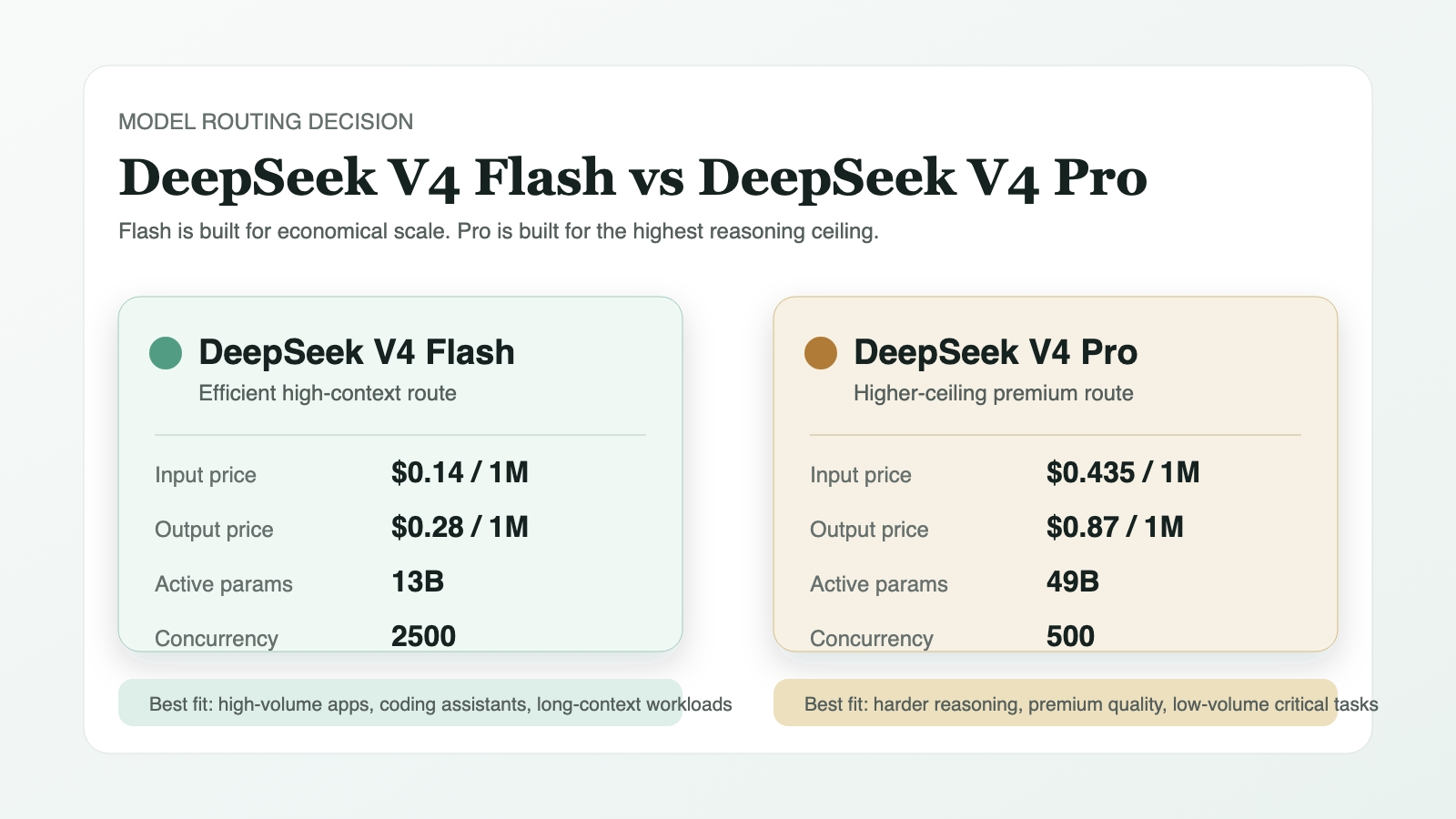
C’est la comparaison que la plupart des pages les mieux classées suggèrent, mais qu’elles n’expliquent souvent pas assez clairement.
Flash est le modèle d’efficacité.
DeepSeek V4 Flash est le meilleur choix lorsque vos principales questions sont :
- Puis-je me permettre de le servir à grande échelle ?
- Puis-je garder une latence raisonnable ?
- Puis-je toujours obtenir une qualité de codage et de raisonnement élevée ?
Les tarifs officiels montrent pourquoi Flash attire autant l’attention. Sur la page API de DeepSeek :
- Flash:
$0.14entrée /$0.28sortie par 1M tokens - Pro:
$0.435entrée /$0.87sortie par 1M de tokens
Cela signifie que Pro coûte un peu plus de 3x autant que Flash à la fois en entrée et en sortie, sur la base des tarifs officiels actuels.
Pro est le modèle au plafond le plus élevé
La page de lancement de DeepSeek et les documents techniques V4 indiquent clairement que V4 Pro reste en tête pour les charges de travail plus difficiles en connaissances, en raisonnement et en agents. Si votre travail dépend de l’obtention de la meilleure réponse possible sur les tâches les plus difficiles, Pro reste le choix haut de gamme le plus sûr.
La règle de décision pratique
Si votre produit a besoin de bonne à excellente performance à une échelle significative, Flash est le premier choix le plus judicieux. Si votre charge de travail est de faible volume mais à enjeux élevés, ou si vous optimisez pour le dernier tronçon de la performance de raisonnement sur des tâches d’agent difficiles, Pro mérite le budget d’évaluation.
Comment le mode Thinking change la proposition de valeur
L’un des détails les plus importants dans la documentation actuelle de DeepSeek est que V4 Flash prend en charge à la fois non-réflexion et réflexion modes, et la réflexion est le mode par défaut sur la page de tarification officielle.
C’est important car de nombreuses équipes ne veulent pas un seul comportement de modèle pour chaque route.
Mode non-réflexion
Utilisez le mode non-réflexion lorsque vous voulez :
- latence plus faible
- réponses de chat plus simples
- classification ou extraction légère
- trafic de production à haut débit
Mode réflexion
Utilisez le mode réflexion lorsque vous voulez :
- raisonnement plus puissant
- travail de codage plus difficile
- meilleure analyse en plusieurs étapes
- comportement d’agent plus fiable
La documentation officielle indique que vous pouvez conserver la même URL de base et simplement mettre à jour le modèle vers deepseek-v4-flash tout en utilisant également le guide Thinking Mode de DeepSeek pour contrôler le comportement du modèle.
Les listes de tiers renforcent le même point. La page du modèle d’OpenRouter indique que DeepSeek V4 Flash prend en charge les efforts de raisonnement élevés et xhigh, avec xhigh correspondant au raisonnement maximal. La liste cloud d’Ollama est encore plus explicite, décrivant trois niveaux de fonctionnement :
- sans réflexion
- réflexion
- réflexion maximale
C’est un point de différenciation utile, car cela signifie que Flash n’est pas seulement “bon marché”. Il est réglable.
Le contexte long est la véritable fonctionnalité stratégique.
La fonctionnalité phare de toute la famille V4 est la fenêtre de contexte de 1M tokens.
DeepSeek affirme que son innovation structurelle inclut une attention sparse et une compression par token conçues pour réduire les coûts de calcul et de mémoire pour les contextes longs. La fiche de modèle Hugging Face présente également DeepSeek V4 autour de “Million-Token Context Intelligence.”
Pourquoi cela est important en pratique :
- les dépôts plus volumineux peuvent rester plus longtemps en mémoire de travail
- les flux de travail sur documents longs nécessitent un découpage moins agressif
- les agents peuvent conserver plus d’état sur des tâches plus longues
- les pipelines de support client ou de recherche très gourmands en contexte deviennent plus viables
C’est également là que Flash devient particulièrement intéressant. Beaucoup de modèles à faible coût cessent d’être attrayants une fois que le contexte devient suffisamment grand. DeepSeek essaie de garder Flash convaincant même dans des environnements de production à contexte long.
Ce que les listes de plateformes actuelles vous disent
Les résultats du classement sont utiles car ils montrent où les équipes sont susceptibles d’essayer le modèle aujourd’hui.
API officielle
La documentation de DeepSeek indique :
- URL de base au format OpenAI : https://api.deepseek.com
- URL de base au format Anthropic : https://api.deepseek.com/anthropic
- prise en charge de la sortie JSON, des appels d’outils, de la complétion de préfixe de chat et de la complétion FIM bêta en mode sans réflexion
Cela fait de V4 Flash un candidat sérieux pour les équipes qui développent déjà autour des modèles d’API courants.
TokenHub
TokenHub est une plateforme d’API de modèles, avec un rôle similaire à OpenRouter : elle aide les équipes à accéder aux modèles d’IA et à les router via une couche d’API unifiée, au lieu de connecter chaque fournisseur séparément.
Pour DeepSeek V4 Flash, TokenHub est utile lorsque l’objectif n’est pas seulement de lire les spécifications du modèle, mais de tester le modèle dans un flux de travail API pratique. Si votre équipe gère déjà plusieurs routes de modèles, TokenHub peut faciliter la comparaison de Flash avec d’autres modèles sur le coût, la latence et la qualité des tâches, sans avoir à reconstruire l’intégration à partir de zéro.
Hugging Face
La fiche modèle répertorie :
- Licence MIT
- Utilisation de Transformers
- Exemples de déploiement vLLM et SGLang
- chemins de déploiement locaux et basés sur Docker
Cela compte, car cela donne à Flash un véritable récit de déploiement open-weight, plutôt qu’un récit fermé uniquement basé sur l’API.
OpenRouter
La fiche d’OpenRouter ajoute un signal de marché utile : elle affiche actuellement Flash à $0.09 input / $0.18 output per 1M tokens, inférieur au prix officiel de DeepSeek. Cela ne rend pas OpenRouter “meilleur” par défaut, mais cela montre que Flash entre dans un écosystème de routage compétitif où le prix et le débit font partie de l’attrait.
La page d’OpenRouter répertorie également actuellement une sortie maximale de 65,536 jetons, ce qui est bien inférieur au chiffre officiel de DeepSeek, soit 384K de sortie maximale . C’est un rappel utile que les routes tierces peuvent exposer des limites différentes de la plateforme native.
Ollama cloud
La page cloud d’Ollama est utile pour une autre raison : elle montre comment le modèle est intégré dans des flux de travail concrets. La page met en évidence les modèles de lancement d’applications pour des outils comme Claude Code, Codex, OpenClaw, OpenCode et Hermes Agent. Elle répète également le récit du contexte 1M et cite explicitement trois modes de pensée.
Conseils pratiques de déploiement
La fiche modèle Hugging Face ajoute quelques détails d’implémentation que de nombreuses pages de classement omettent :
- pour un déploiement local, DeepSeek recommande
temperature = 1.0ettop_p = 1.0 - pour Think Max mode de raisonnement, DeepSeek recommande une fenêtre de contexte d’au moins 384K tokens
Ces détails sont utiles car ils donnent aux équipes un point de départ plus réaliste pour l’évaluation, plutôt que de forcer chacun à deviner une base de service.
Alt: Illustration de planification de déploiement montrant les voies d’intégration pratiques de DeepSeek V4 Flash à travers l’API officielle, le service open-weight et les plateformes tierces.
Meilleurs cas d’utilisation pour DeepSeek V4 Flash
D’après la documentation officielle, les listes de plateformes et la combinaison de classement actuelle, V4 Flash semble le plus performant dans ces situations :
1. Assistants de codage à haut volume
Le modèle est positionné pour des workflows de codage et d’agents solides, mais son prix le rend beaucoup plus facile à justifier pour une utilisation interne ou client à grande échelle.
2. Workflows d’entreprise à contexte long
Si votre application travaille régulièrement sur de grands documents internes, des dépôts ou des collections de recherche, le contexte de 1M importe plus qu’une autre petite amélioration de benchmark.
3. Systèmes d’agents qui nécessitent une discipline de coût raisonnable
Les notes de version de DeepSeek indiquent que Flash est à égalité avec Pro sur les tâches d’agent simples. Cela rend Flash particulièrement intéressant pour les systèmes multi-étapes où le coût se cumule sur de nombreux appels.
4. Équipes migrant depuis les anciennes routes DeepSeek
C’est un angle négligé mais important. DeepSeek déclare deepseek-chat et deepseek-reasoner sera retiré le July 24, 2026, 15:59 UTC, et correspondent actuellement aux modes non-pensant et pensant de V4 Flash. Pour les équipes utilisant déjà ces noms, V4 Flash n’est pas simplement une nouvelle option. Cela fait partie du chemin de migration à court terme.
Risques et Mises en garde
Cet article serait incomplet sans les compromis.
Le statut de préversion compte toujours
DeepSeek qualifie cette version de préversion. Cela signifie que la tarification, le comportement, la documentation et la prise en charge de la plateforme peuvent encore évoluer rapidement.
Pro reste meilleur sur les tâches les plus difficiles
Les propres documents de DeepSeek indiquent clairement que Flash est le modèle d’efficacité, pas le modèle plafond absolu. Pour les charges de travail de raisonnement ou d’agent les plus exigeantes, Pro reste en tête.
Les détails de la plateforme hébergée peuvent différer
Les fournisseurs tiers peuvent proposer des tarifs, des routages, des disponibilités ou des sémantiques d’utilisation différents de ceux de l’API officielle. Utilisez-les pour plus de commodité ou de diversification, mais ne supposez pas que chaque comportement correspond exactement à la plateforme native de DeepSeek.
Le mode de réflexion peut modifier le coût total
Un prix unitaire bas ne signifie pas toujours une facture finale basse. Des traces de raisonnement plus longues et des sorties plus volumineuses peuvent encore faire augmenter le coût total si vos charges de travail ne sont pas bien cadrées.
Recommandation
DeepSeek V4 Flash n’est pas intéressant parce qu’il n’est qu’un “DeepSeek moins cher”. Il est intéressant parce qu’il combine quatre éléments qui apparaissent rarement ensemble dans un seul ensemble :
- contexte officiel de 1M
- comportement de réflexion réglable
- options de déploiement à poids ouverts
- tarification API officielle très agressive
Si vous avez besoin d’une capacité maximale pour les tâches les plus difficiles, évaluez aussi V4 Pro. Mais si vous recherchez le modèle le plus susceptible d’offrir un bon équilibre entre vitesse, raisonnement, coût et flexibilité de déploiement, DeepSeek V4 Flash est le meilleur point de départ pour de nombreuses équipes de production réelles.
FAQ
Qu’est-ce que DeepSeek V4 Flash ?
DeepSeek V4 Flash est le modèle axé sur l’efficacité de la famille de préversion V4 de DeepSeek. Il a été officiellement annoncé le 24 avril 2026 et prend en charge une fenêtre de contexte de 1M de jetons avec des modes de réflexion et de non-réflexion.
Combien coûte DeepSeek V4 Flash ?
Sur la page de tarification API officielle de DeepSeek, V4 Flash est listé à $0.0028 par 1M de jetons d’entrée en cache, $0.14 par 1M de jetons d’entrée hors cache, et $0.28 par 1M de jetons de sortie.
DeepSeek V4 Flash est-il open source ?
La fiche du modèle Hugging Face répertorie le modèle sous une licence MIT, et la page de publication de DeepSeek indique que l’aperçu V4 est open source. En pratique, il est préférable de le considérer comme un modèle à poids ouverts avec de réelles options d’auto-hébergement et de déploiement dans l’écosystème.
Quelle est la fenêtre de contexte de DeepSeek V4 Flash ?
La documentation officielle de DeepSeek et plusieurs listes de plateformes indiquent actuellement une Fenêtre de contexte de 1M de jetons.
Dois-je utiliser DeepSeek V4 Flash ou DeepSeek V4 Pro ?
Utilisez Flash lorsque le coût, le débit et l’aspect pratique du contexte long comptent le plus. Utilisez Pro lorsque votre charge de travail est de faible volume mais nécessite le plafond de raisonnement le plus élevé que DeepSeek offre actuellement.